
From the world’s most heavily fortified border in the world, visitors to the Odusan Unification Observatory in South Korea can get a rare look at life across the Demilitarized Zone, inside North Korea.
An unusually clear day on Tuesday provided crystal-clear views across the Han River, where workers were farming the land about a mile away from the observation point on the South Korean side of the demarcation line.
Inside a North Korean village
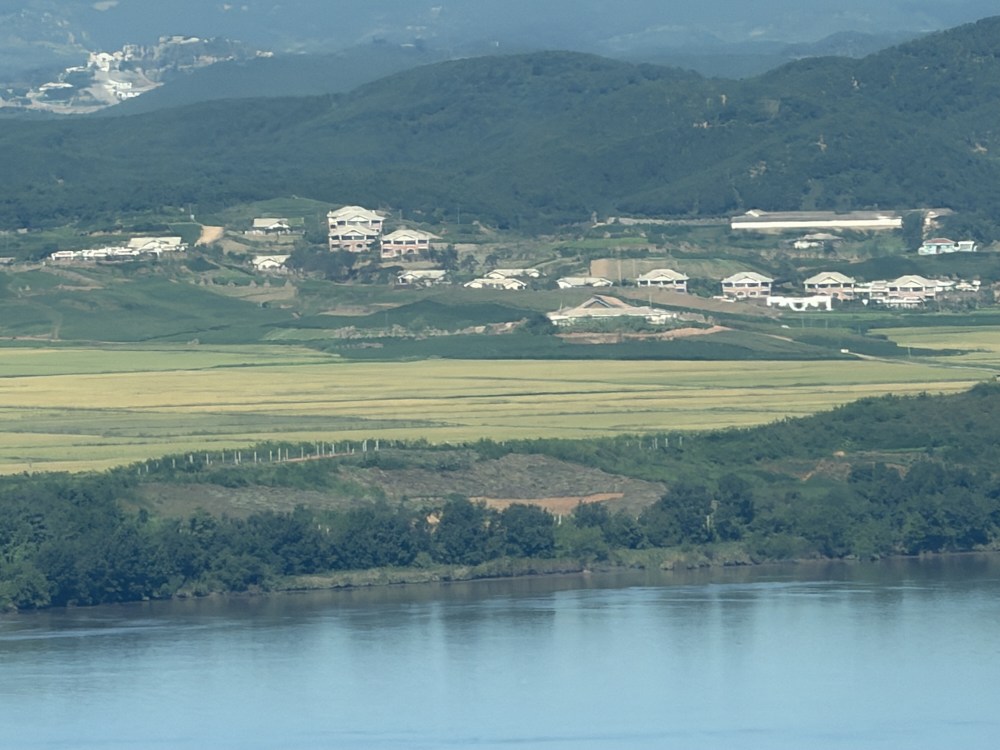
The Gwansan Peninsula is home to a rural village of about 4,000 North Koreans. The village includes 70 newly constructed homes in the foothills, a public cultural hall, an elementary school and the Kim Il-Sung Memorial Hall, dedicated to the North’s former leader.
A photojournalist’s firsthand account
Korean-born American photojournalist Hyungwon Kang has a unique perspective on changes in North Korea over the last two decades. In April, he spent two weeks traveling across North Korea, photographing daily life as part of an ongoing ‘Visual History of Korea’ project.
After a 33-year career as a professional journalist at the LA Times, The Associated Press, and Thomson Reuters, the Pulitzer Prize-winning photojournalist has shifted his work to research, now as an author and visual historian.
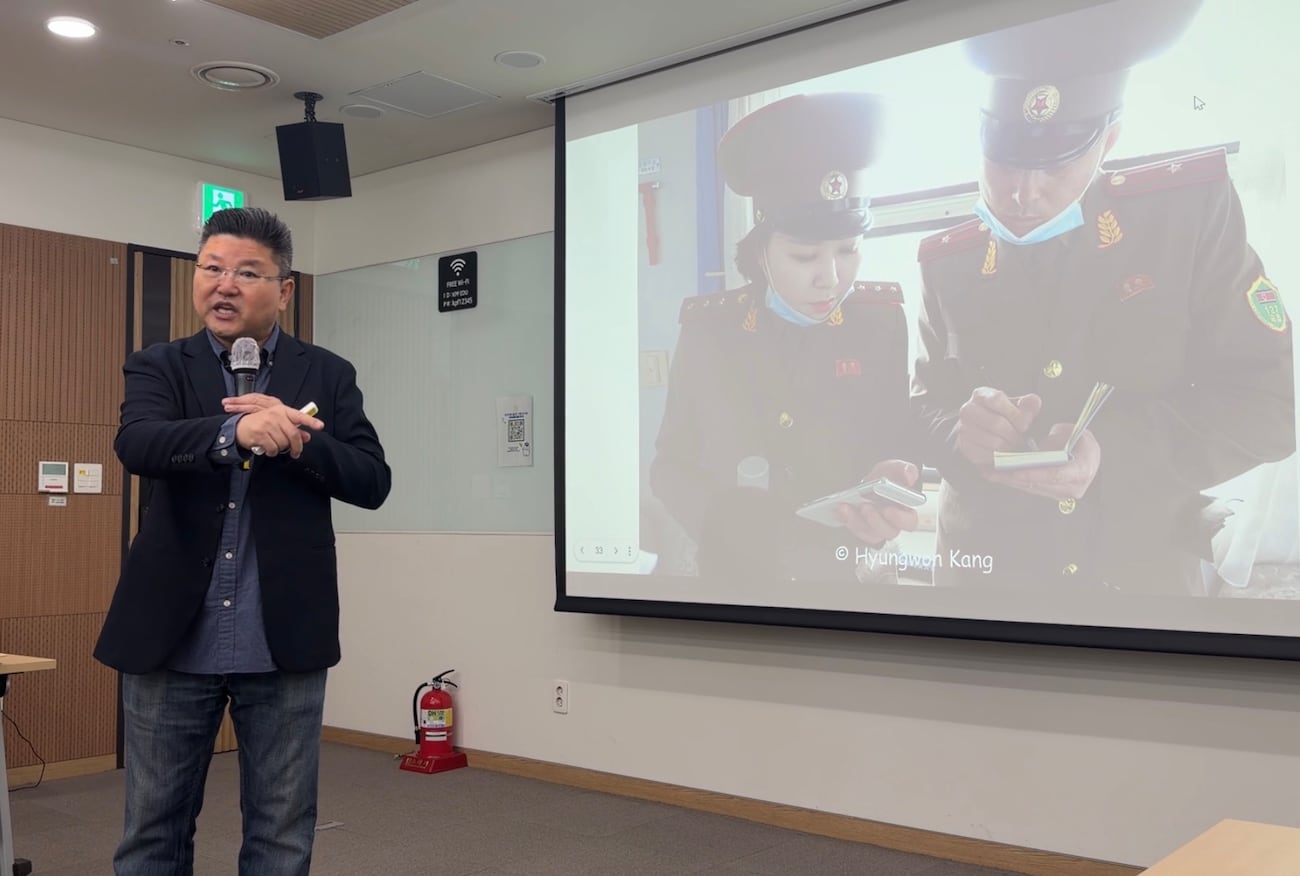
Kang was one of the first Western journalists allowed into North Korea after it closed its borders during the COVID-19 pandemic. After taking a train across the border with China, he says his journey to Pyongyang and Kaesong and throughout the countryside revealed incremental improvements in daily life since his last visit in 1997.
“North Korea is a highly-segregated society, meaning if you are a resident of one city, you cannot freely travel to other cities. So most defectors, they can tell you about where they lived, but they cannot tell anything else about what happened outside of their area. So you have to take whatever they say with a grain of salt knowing that they do not know because we have other access to other information,” Kang said.
Focusing on anything new that stood out, Kang says he observed stark differences: trucks delivering gasoline in rural villages, solar panels on rooftops, air conditioning units on buildings in the capitol city, children reading Harry Potter books, North Koreans using cell phones, license plates required for bicycles, and a seemingly greater number of obese people, which may be a measure of the availability of food.
After noticing a number of people tending farmland in “street clothes,” Kang says he was told city dwellers in North Korea are required to spend a month each year in the country to assist with farm production.
Shifting views on reunification
Kang’s interaction with North Koreans also led to conversations on the changing sentiment about reunification in the North.
“In fact, I went to a book store. I couldn’t find any dictionaries or maps, so I asked him what’s going on. He says, ‘oh, the government, they took all the books. They retrieved all the books and dictionaries to remove unification from their vocabulary,” Kang said.
Kang says this change is a result of the previous South Korean administration’s relationship with the North, which included sending drones to Pyongyang.
“I’m hearing more people saying that we have to be more realistic and recognize North Korea as a state.”
In response, there are reports that North Korea started building a border wall along its side of the Military Demarcation Line.
Back in South Korea, Kang says the young generation are especially skeptical about the idea of reunification.
“It’s going to cost our economy too much. We’re all going to be poor having to feed those people. We don’t want reunification. That’s the majority tendency in South Korea.”
The views expressed in this blog do not necessarily reflect the views of KLTV/KTRE-TV or Gray Media. They are solely the opinion of the author. All content © Copyright 2026 Lane Luckie


